At 4:47 p.m., a product manager pastes the PRD an AI generator just wrote into the team channel: “an administrator should be able to export customer data”. An agent opens a plan, and the first pull request reveals that no one decided permissions, fields, volume, or format. An AI PRD generator speeds up the draft, but only a reviewable spec turns ambiguous requirements into an execution contract for engineering and coding agents.
A PRD and a spec solve different problems
The sentence from that afternoon did not fail because it lacked fluency. A PRD organizes product context, including the problem, audience, opportunity, objectives, and scope; a spec translates that context into an executable unit of decision. It identifies behaviors, states, data, interfaces, and boundaries an implementation must respect.
Natural-language output can sound confident and remain ambiguous. Any sentence that permits two incompatible implementations needs another review before it reaches an agent.
- PRD: why the product is worth building and which outcome matters
- Spec: what must happen in each relevant scenario
- Plan: how the system and team will deliver the change
- Tasks: which units can be implemented and validated
The requirements-to-spec pipeline
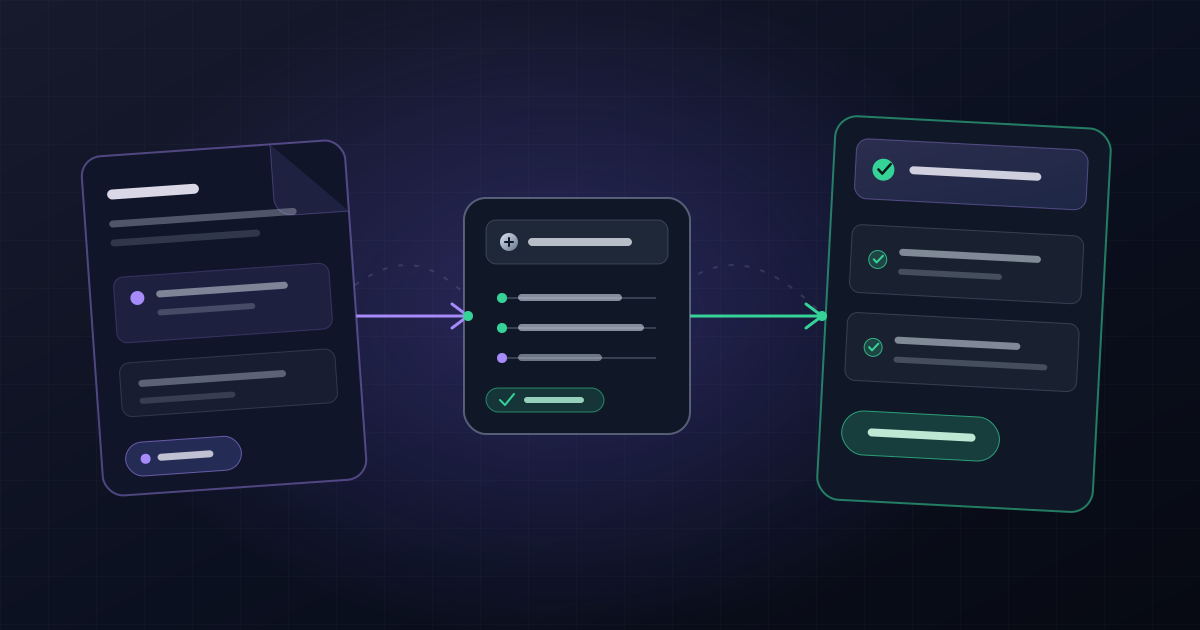
The transformation starts by preserving the origin of each decision. PRD goals become observable outcomes; journeys become scenarios; policies become rules; questions become open decisions. The team gets a map of what is agreed and what still blocks safe execution.
This pipeline is the difference between using AI to produce text and using AI to produce dependable work. The draft can start in any generator; value appears when the team can review each decision before handing the task to a developer or coding agent. Before decomposing the work into tasks, move through four passes:
- Normalize terminology and actors to prevent conflicting synonyms
- Make conditions, permissions, empty states, and failures explicit
- Connect requirements to affected interfaces, data, and dependencies
- Write observable acceptance criteria without prescribing code too early
Review before the coding agent
AI can propose structure and surface questions, but it has no authority over priorities, risk, or business rules. Human review decides which assumptions may become decisions. Product confirms intent; design checks the experience; engineering tests feasibility; security and data specialists inspect the relevant boundaries.
After approval, the same spec can guide planning, tasks, tests, and implementation. When a requirement changes, the change returns to the contract and becomes visible to every downstream consumer instead of living in a side conversation.
teoai as a bridge, not a text editor
teoai is not a PRD generator. It is a platform for turning product material into reviewable specs before a developer or coding agent starts executing. The PRD is raw material; the output that matters is a clear contract of behavior, rules, exceptions, and acceptance.
In the export example, teoai would enter after the first draft: “export customer data” becomes questions about authorized actors, allowed fields, format, volume, auditability, and empty states. Approved answers become criteria the team can review and the agent can use without inventing business policy.
That is the bridge many AI workflows miss. A good PRD explains why something matters; teoai organizes what must be true for delivery to work. Product gains speed without pretending the draft is ready, engineering gets precision without receiving a wall of prose, and the enterprise reduces the risk of delegating sensitive decisions to a model.
From an ambiguous requirement to verifiable acceptance
Consider the sentence: “an administrator should be able to export customer data”. It sounds concrete, but it leaves open who may export, which fields belong in the file, how an account with no data behaves, which format is allowed, and what happens when the export is large. An AI PRD generator can make the sentence smoother; it cannot choose those policies on its own.
A useful transformation separates the outcome from the decisions. The team defines the authorized actor, field set, format, volume limit, and failure behavior. It then records examples that let a product person, a developer, and an agent reach the same interpretation without relying on private memory.
The example shows why acceptance criteria are more than a QA checklist. They are a negotiation surface: they make the rule testable, expose permission dependencies, and state what is outside the first version.
- Primary scenario: an authorized administrator requests a CSV of approved fields
- Permission scenario: a user without the capability receives a denied, auditable response
- Volume scenario: an export over the limit becomes an asynchronous job with status
- Data scenario: an account with no records produces a valid but empty file
- Acceptance criterion: every behavior can be demonstrated without inspecting hidden intent
What changes for enterprises and developers
For an enterprise, the benefit is preserving decisions through the tools that already organize work. The PRD can remain in the product workspace, the backlog can remain in the planning system, and implementation can remain in repositories. The spec connects them with a reviewable version of behavior instead of creating a competing copy of every source.
For developers, the change is receiving fewer aspirational sentences and more useful contracts: inputs, outputs, states, boundaries, dependencies, and evidence. That makes the conversation with an agent more productive because code exploration answers “how does this fit?” instead of inventing “what did product mean?”.
The connection also improves prioritization. A gap found during implementation can return to the requirement as an open decision; a scope change can update the scenarios that depend on it. In a workflow with teoai, that feedback does not disappear inside a pull-request comment: it returns to the spec that guides the next work slice.
- Product validates outcome and priority before requesting technical decomposition
- Engineering identifies contracts, migrations, and operational impact
- Security and data specialists review permissions, retention, and exposure
- Developers receive tasks tied to scenarios rather than only components
- Agents inherit approved decisions without becoming the source of policy
Limitations and when not to use it
An AI PRD generator is not a domain authority and should not be treated as automatic approval. It can organize interviews, compare formulations, and suggest questions, but an enterprise still needs people who understand customers, contracts, operations, and regulatory risk to close decisions.
Not every document needs to become a detailed spec. An exploratory note with an unvalidated problem, a small visual adjustment, or a well-bounded technical task can stay lightweight. Conversion is valuable when ambiguity, cross-team dependency, or the cost of a wrong agent interpretation is material.
There is also a limit to verifiability. If the outcome depends on a metric that does not exist, an undecided policy, or human behavior that cannot yet be observed, the next step is creating a way to measure and decide—not asking a model to invent a criterion.
- It does not turn insufficient research into product certainty
- It does not replace user validation, legal review, or security analysis
- It should not hide open decisions behind confident language
- It does not need to impose one format on every type of requirement
Questions and answers
Question: should I ask AI for a complete PRD or a complete spec in one pass? Answer: start with the smallest slice that allows intent and risk to be reviewed. A sequence of questions, scenarios, and open decisions usually produces a more dependable contract than a long document generated in one round.
Question: what should we do when the PRD and code use different terms? Answer: create a domain vocabulary and choose canonical forms for actors, states, and objects. The spec can record useful synonyms for search, but its implementation criteria should use the canonical terms.
Question: how does a developer know a spec is ready for execution? Answer: primary, alternative, and failure scenarios have observable behavior; dependencies and open decisions are visible; and someone with product authority has confirmed that the contract represents the desired outcome.
Sources and further reading
Your PRD does not need to die as a polished document.
Explore teoai and turn requirements into a living spec product can review, engineering can trust, and agents can execute.
Follow updates