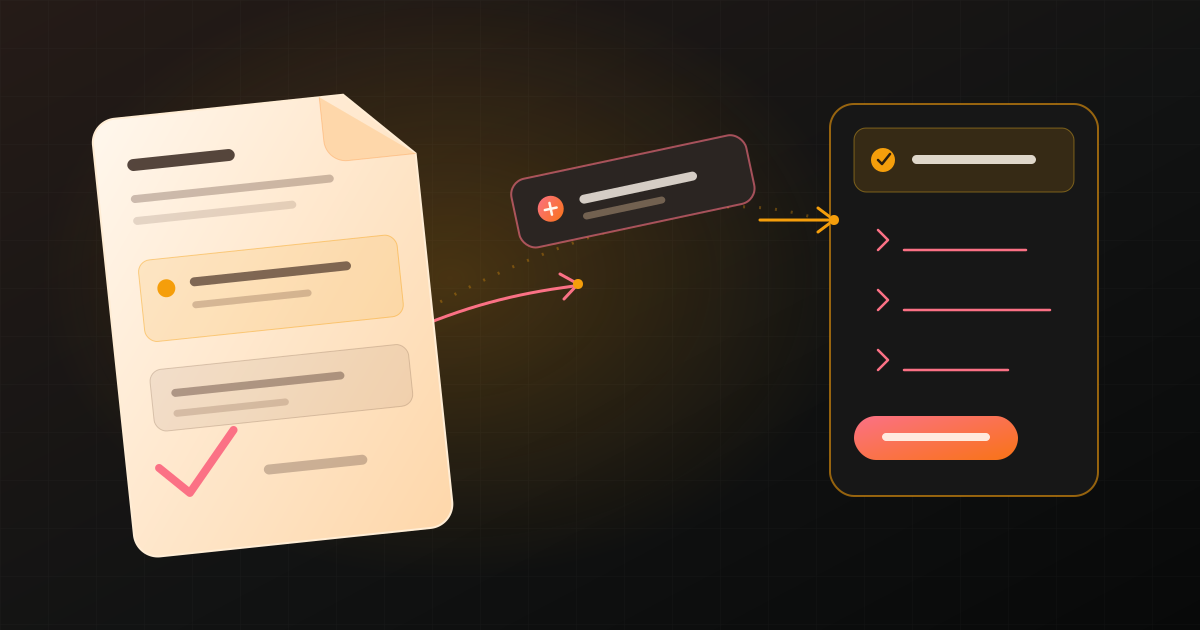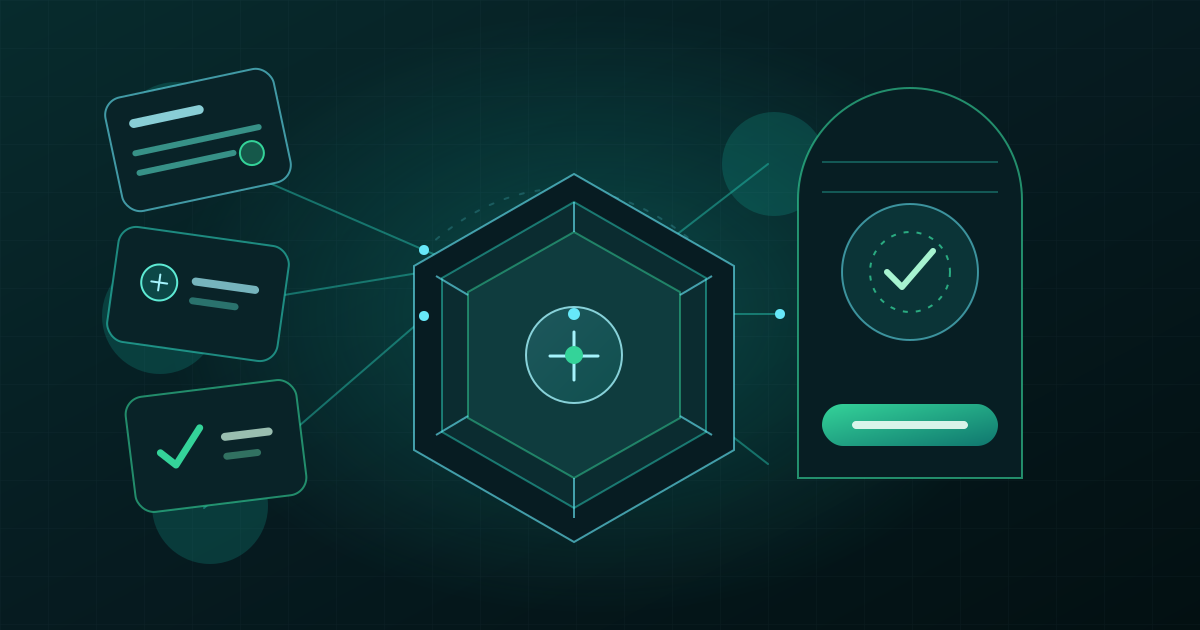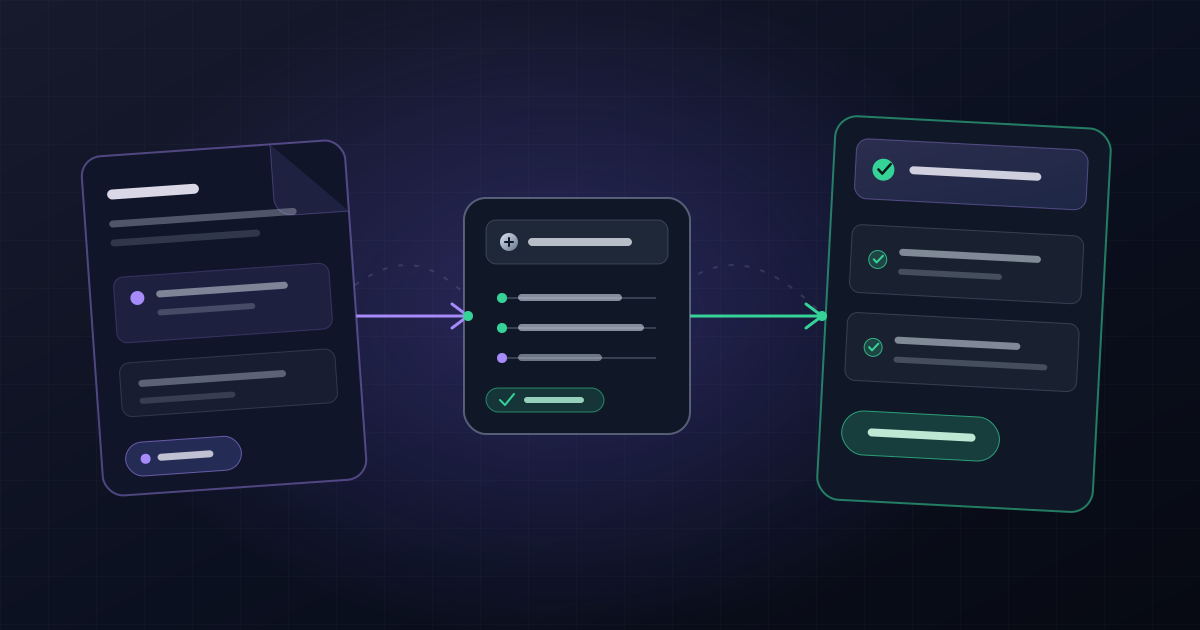
On Monday, an enterprise approves a billing change and sends the same briefing to product, security, engineering, and a coding agent. By Friday, each group has a different interpretation of what it means to export data safely, and the pull request becomes the place where policy is discovered. Enterprise spec-driven development prevents that drift by keeping intent, rules, and acceptance criteria in a living spec that can be reviewed before implementation.
A spec is an operating agreement
That kind of week is exactly what a spec should interrupt. A briefing explains the opportunity; a spec defines the execution contract by connecting the desired outcome to domain rules, technical boundaries, and the evidence that will prove the work is complete. Without that bridge, every handoff becomes another interpretation step.
A useful spec does not predict every line of code. It preserves what must not be lost while leaving engineering room to choose the strongest implementation.
- The objective and an observable user or business outcome
- Relevant actors, states, rules, exceptions, and dependencies
- Scope boundaries and decisions that remain open
- Acceptance criteria that people and automation can verify
From briefing to a reviewable spec
The flow starts with a conversation, a document, or a body of evidence. Instead of sending that material straight into implementation, the team normalizes the intent and exposes gaps first. Questions about permissions, error states, integrations, and data no longer arrive late in a pull request.
This is where the topic stops being documentation and becomes operational speed. When the contract is clear, the coding agent does not have to infer what product meant; it can inspect the repository to discover how the change should fit. A compact sequence works better than rigid ceremony:
- Capture the problem, audience, and desired outcome
- Separate facts, assumptions, constraints, and pending decisions
- Model primary, alternative, and failure scenarios
- Review the contract with product, design, engineering, and security
- Version the decision and connect changes to the matching implementation
Governance without another silo
Enterprise adoption breaks down when the spec becomes one more isolated file. The artifact has to participate in the real flow of review, planning, development, testing, and change. Different disciplines can deepen the same contract without creating competing versions of intent.
Detail should follow risk. A reversible change may need a short spec; a regulated, cross-team, or data-migration change needs more evidence, ownership, and criteria. The discipline is making the level of rigor an explicit choice.
Where teoai fits
teoai is an early-access platform for product and engineering teams that need to turn briefings, documents, and conversations into living specs. It is not another coding agent; it is the context-governance layer before the agent, where a decision is organized, reviewed, and approved.
In the workflow described here, it enters after intent is discovered and before implementation starts. The team brings the briefing, captures open questions, turns answers into rules, defines acceptance criteria, and keeps everything in a spec that can connect to the repository and guide coding agents without relying on meeting memory.
That makes the product case straightforward because it comes from the problem itself: if your company already uses Cursor, Claude, Codex, OpenCode, or another agent, the risk is not a lack of code generation. The risk is giving the agent an incomplete decision. teoai exists to reduce that risk without taking decision authority away from product, security, or engineering.
Why this shared contract matters to an enterprise
In an enterprise, the same decision often crosses product, architecture, security, data, and several delivery teams. A shared spec reduces context loss between those groups without pretending that everyone must work in one repository or at the same level of detail. It makes ownership, accepted risk, and missing evidence visible.
The value becomes clearest when a change touches more than one system. The business outcome can remain stable while the technical decomposition changes: an integration may be replaced, a service split, or a migration given an intermediate step. The spec preserves intent while making it possible to review strategy without rewriting the history of why.
This also improves continuity. When someone leaves a project, an auditor asks where a rule came from, or another team takes over maintenance, the contract is a stronger reference than scattered messages. Governance becomes more than a final approval; it follows the decision from its first meaningful draft.
- A business decision traceable to scenarios, criteria, and implementation
- Owners and reviewers assigned by risk rather than fixed ceremony
- Cross-repository and cross-team dependencies recorded before execution
- Strategy changes kept distinct from changes to the original intent
- Enough evidence for operations, security, and audit conversations
What changes for developers
For developers, spec-driven development does not mean receiving a larger document and following a recipe. It means starting with a task whose purpose, boundary, and stopping condition are explicit. Developers still investigate the code, choose abstractions, and negotiate trade-offs; they simply do not have to guess rules that should have been decided earlier.
For a feature spanning a front end, an API, and persistence, the spec can describe user behavior and divide the work into units with clear contracts. Each repository receives its slice, dependencies, and verification. An agent can explore local patterns and prepare changes, while review checks that the slice remains faithful to the larger contract.
The loop gets shorter when a failure returns to the right place. If code misses an explicit criterion, improve the implementation or validation. If the criterion missed a domain rule, update the spec before requesting another generation. A tool like teoai helps at exactly that point: the correction returns to the spec instead of disappearing inside a pull-request comment.
- Read business context before opening a trail of implementation files
- Confirm integration contracts and failure cases before coding
- Use an agent to explore and propose without delegating decision authority
- Validate each unit with tests, inspection, and evidence from the real scenario
- Return intent gaps to the contract instead of hiding them in local comments
Limitations and when not to use it
A spec cannot resolve a decision that has no owner. If product, engineering, and security disagree about the outcome, formalizing the ambiguity only produces a polished document with unresolved risk. The first step has to be the conversation that decides priority, policy, and responsibility.
A heavy ritual is also unnecessary for every change. A reversible copy edit, a well-understood mechanical fix, or an isolated adjustment may fit the normal review flow. Rigor should follow impact, uncertainty, and cost of reversal rather than an arbitrary page-count target.
In legacy systems, trying to describe everything before touching anything creates an inventory no one can review. Start around the change, record observed behavior, and grow coverage as bugs, features, and refactors reveal more rules. A spec is useful when it remains reviewable.
- It does not replace tests, observability, security review, or human judgment
- It should not freeze a technical solution while the problem is still being discovered
- It is not a reason to copy irrelevant context from every repository
- It loses value when abandoned after the first deployment
Questions and answers
Question: does a spec have to be written before any conversation with an agent? Answer: no. The conversation can help discover gaps and alternatives; the control point is consolidating and reviewing consequential decisions before autonomous execution.
Question: who owns the spec when a change crosses teams? Answer: the outcome owner coordinates intent, while each discipline owns its risk slice. A simple map of owners and reviewers prevents the document from becoming engineering's private property.
Question: how do we know whether a spec is too vague or too detailed? Answer: ask someone outside the original conversation to explain the behavior, boundaries, and acceptance evidence. If they still have to guess the rule, clarity is missing; if they have to read disguised implementation, there is too much detail.
Sources and further reading
The next bottleneck does not need to become another lost prompt.
Join the teoai waitlist to turn briefing, review, and coding agents into one living-spec workflow.
Join the waitlist